Farm-to-Table: “Cold Brine Mustard Pickles” for the “Casual Cook” — Home Canning 101
 Maylee at Beyond Gumbo
9 min read
Maylee at Beyond Gumbo
9 min read

This recipe, “Cold Brine Mustard Pickles,” is for anyone who wants to participate in the farm-to-table movement, but doesn’t want to invest in all the time and equipment needed for home canning (which is an all day process). Thanks to the availability of all kinds of greenhouse cucumbers in grocery stores these days, this recipe is extremely easy to make. My recipe attempts to replicate the “Sour Mustard Pickles” which my husband loved so much when he was growing up. Alas, I never thought to ask his mother for the recipe when she was able to provide it. My husband remembers that these were refrigerator pickles and full of mustard seed. They were crisp, bright green and were made with whole cucumber spears. The pickles were stored in the refrigerator in a large ceramic crock with a plate to weight down the pickles — just reach in and get a snack whenever you wished. Basically, I’m thinking that these were salt-brined cucumbers. They were cured and stored in the refrigerator — rather than heat or pressure processed using home canning equipment and methods. The good news is that we can make these pickles with ingredients which are easy to acquire. The recipe is quick and easy. It does use a few of the same principles of home canning, so planning is important. The hardest part is waiting several days for the cucumbers to “cure.”

“Small Batch” Easy Recipe
My “Cold Brine Mustard Pickles” are delicious! They have lots of flavor due to all the spices plus garlic which I packed into the jars along with the cucumbers. These pickles will disappear quickly — so my plan is to mix up a few jars every few days. After you assemble the spices and supplies (canning or other jars), then you are ready to make these pickles on a regular basis.
Timing is everything when making pickles or other home canned produce. Once everything is ready, these pickles take just a few minutes to make. The key is to get everything ready at the same time — hot sterilized jars, hot brine, and cucumber and garlic sliced and ready to go.
I have made my recipe over and over to “tweak” the process and ingredient quantities. I came up with a process which uses 1-1/2 lb cucumbers. It is a small batch and fills two (1 pint — i.e.16 oz) commercial canning jars or one (28 oz) Classico® Atlas Mason pasta sauce jar.

Let’s Get Ready
The supplies needed for this project are:
- Canning or other suitable jars — with tight fitting and clean lids (don’t forget the lids),
- Mini-cucumbers — no more than 5″ in length,
- Garlic and aromatic spices,
- Ingredients for pickling brine.
Canning Jars
Two types of jars can be used for this recipe: commercial brand canning jars or sturdy Classico® Atlas Mason pasta jars.
Both these glass jars can easily be sterilized in a dishwasher in high heat or in boiling water. Don’t be tempted to substitute plastic jars which can’t be sterilized. Other types of glass jars may be too thin to accomodate boiling water and/or hot pickle brine.

I do sterilize the jars and lids — that’s my one holdover from home canning. But that’s easy; just wash and dry on high heat of dishwasher – or place the jars and lids in a large pot of boiling water for 5 minutes.
Commercial canning jars are the best. I use one pint-capacity jars. These jars are easy to locate in large chain stores such as Walmart, Alberstons, Lowes and Home Depot. Brands include Ball, Kerr and Mason jars. You can purchase either a 4-jar pack or a 12-jar pack. These jars have a 2-part lid and ring which seals the contents which you are canning . And these these jars can be over and over — although you may need to replace the lids (rings and seals). If you aren’t interested in making 12 jars of pickles, the jars are good for all kinds of other things, too. Mix up salad dressings, store dry pasta or rice in the jars, use them to store simple syrup for mixed drinks.
The two-part rings and seals are sold with the jars. Replacement lids and rings are also sold separately and can be replaced, if needed. Plus, I accidentally purchased some one-part lids which fit these standard-size jars. But. that’s okay.

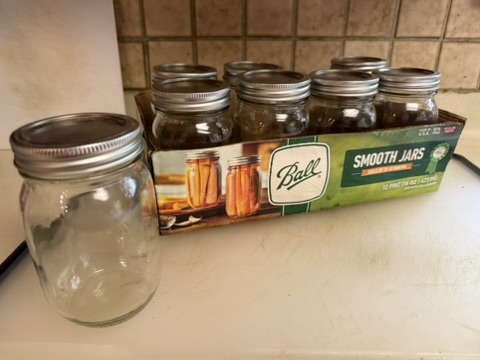
Leftover Classico® pasta sauce jars can be used in a pinch after finished using the sauce in other recipes. However, a word of caution here. Although the jars are labeled as “Atlas Mason” jars, I discovered that this is a marketing “gimmick.” These jars are not true Mason brand jars intended for canning. According to the manufacturer, Kraft-Heinz Company, Classico® pasta sauce jars intended as “single use” jars. The glass is thinner — for lighter weight and less transit cost — and may not hold up to high-temperature water bath or pressure canning. Plus, Classico® pasta sauce jars are smaller than quart-size canning jars; the pasta sauce jars hold only 24 or 28 ounces (3 to 3-1/2 cups). A quart jar holds 32 ounces. This can be confusing when trying to follow recipes.
In my recipe, I don’t used pressure canning or a hot water bath to process the jars. The Classico® pasta jars have worked for me when making these pickles. However, I do pour boiling picking brine over the cucumbers which are packed in the jars. And, you can’t pour boiling brine into a cold jar — any jar may crack and break (I’ve had that happen) so the empty Classico® jars (or any jar) must be hot when you get ready to add the cucumber spears and hot brine.

Greenhouse Farming vs Farmer’s Market Cucumbers
My “go to” cucumbers for making pickles have always been ones which I’ve grown in my own garden or purchased from a farmer’s market. I love the flavor, but they have some disadvantages — mainly they are not always available. Plus, you really need small cucumbers (under 5″ length) to make whole pickle spears. Traditional cucumbers found in farmer’s markets and grocery stores are often larger than this. And, ones sold in stores often have a waxy coating added.
Enter greenhouse cucumbers…This year, my husband started bringing home mini-cucumbers from grocery stores. These little cucumbers make great snacks. Since they are grown on upright vines in a greenhouse, they have thinner skins and are not coated with wax. They are uniform in size and rarely have blemishes. Plus, these mini-cucumbers always seem to be available. Perfect for making brined pickles. And, they are conveniently sold in 1-lb bags. Here are bags from Albrertson’s and Walmart.


Pickling Brine Ingredients
The second part of making mustard pickles is the brine as the the cucumber spears are “pickled” by letting them steep in the mixture of spices, vinegar, salt and water. My brine includes fresh garlic cloves, mustard seed and a few black peppercorns. As optional ingredients, I added celery seed and coriander. After making many batches, I have tweaked the ingredient proportions so the brine isn’t too tart or sour and it isn’t too salty. In other words, it is just right.
This recipe doesn’t contain dill. These are simple mustard pickles. Dill takes the pickles in another direction. However, if desired, a dill seeds could be added to each jar.
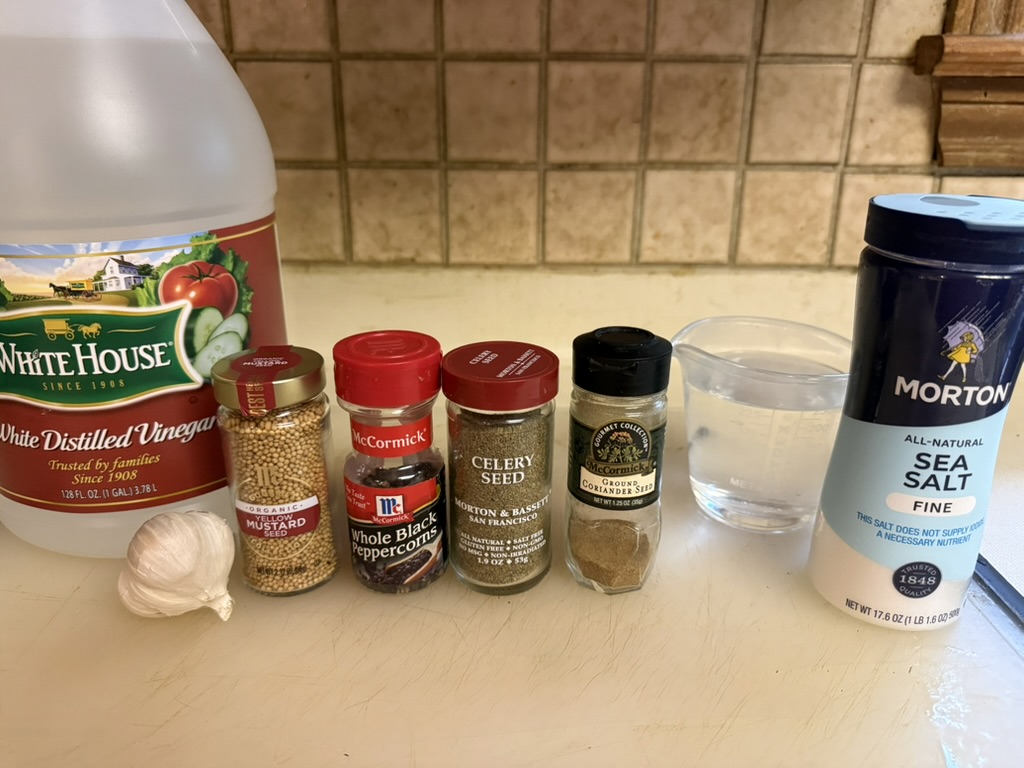
For this recipe, I used white distilled vinegar (5% acidity) rather than apple cider vinegar. The cider vinegar was too astringent. Although this photo shows fine sea salt, regular salt can be used, too.
To make the pickling brine, I add the water, vinegar and salt to a small, clean pot. Bring to boil to dissolve the salt. Then let it set until ready to use. If needed, reheat just before pouring into the hot, sterilized jars. I add the garlic and spices directly to each jar. So set them aside until ready to finish the pickles.

Making the pickles — get everything ready.
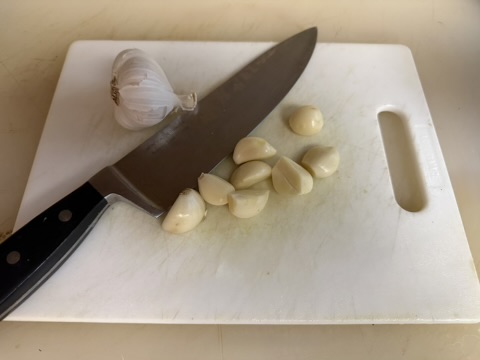
Get the cucumbers and garlic ready. I add one large garlic clove to each jar. So that’s easy — peel either one large or two small garlic cloves for each jar. Here, I’m making several batches of pickles.
Get the cucumbers ready. Inspect them, discard any which are soft or old. Rinse and dry. Cut off a bit of both ends — especially the blossom end. Slice the cucumbers lengthwise, into 4ths for large cucumbers.
The blossom end is the smaller pointed tip. It contains enzymes which can cause the pickles to soften and become mushy.

Get the jars ready. Home canning usually involves add the food to sterilized jars. Because food safety is so important, I still sterilize the jars. I either wash the jars in the dishwasher on heated settings or add them to a large pot of water on the stove and boil the jars for 5 minutes. And, I wash and sterilize the rings and caps, too. I try to time this step so the hot jars are ready to be filled as soon as they come out of the dishwasher (or stove).
Timing is everything
So, we have everything ready…..hot jars, brine which can be quickly re-heated on the stove, cucumber spears and garlic cloves. Spices are on standby. It is time to fill the jars.
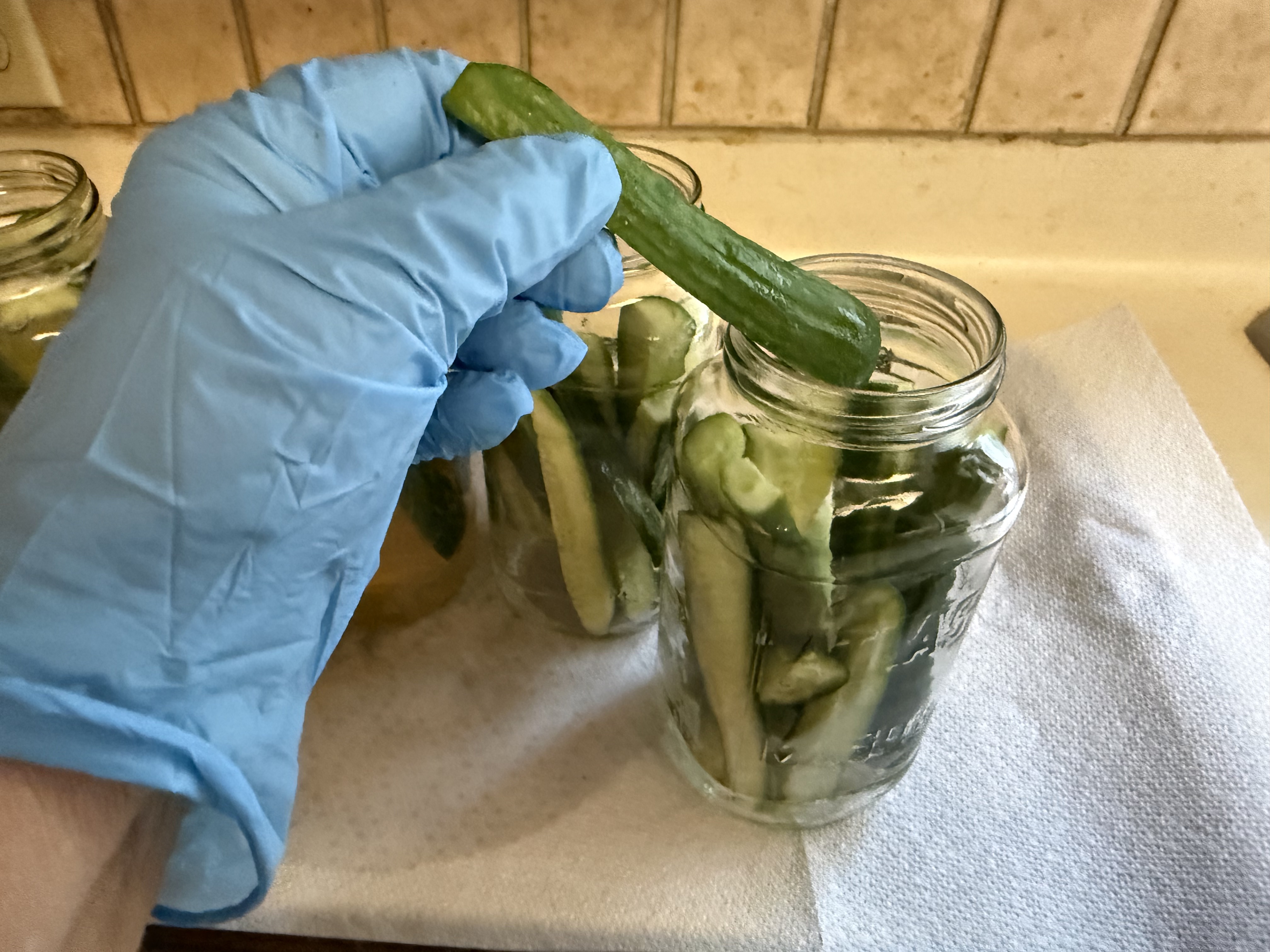
Fill the hot jars with the cucumber slices. The two (one-pint) jars accommodated 1-1/2 pound of sliced cucumbers. Pack the cucumbers in to fill the jars. (If not packed in, the cucumbers will float in the brine to the top of the jars.) Pour hot brine into the jars leaving at least 1/2-inch at the top of the jar but making sure the cucumbers are covered with the brine. Make sure the brine is hot and that the salt is dissolved.
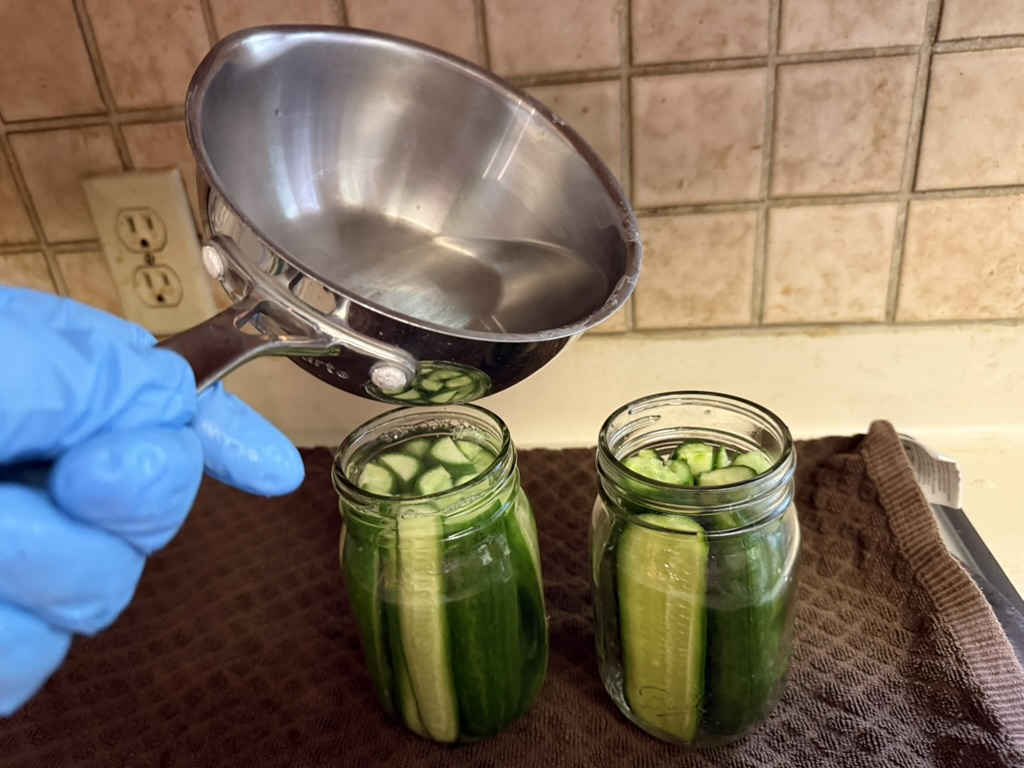
Add one large garlic clove to each jar. Then pour in 1 tsp mustard seed into each jar followed by 3 black peppercorns to each jar. Add 1/8 tsp celery seed and 1/8 tsp corrinder seed, to each jar, if using. Screw on new rings and seals.

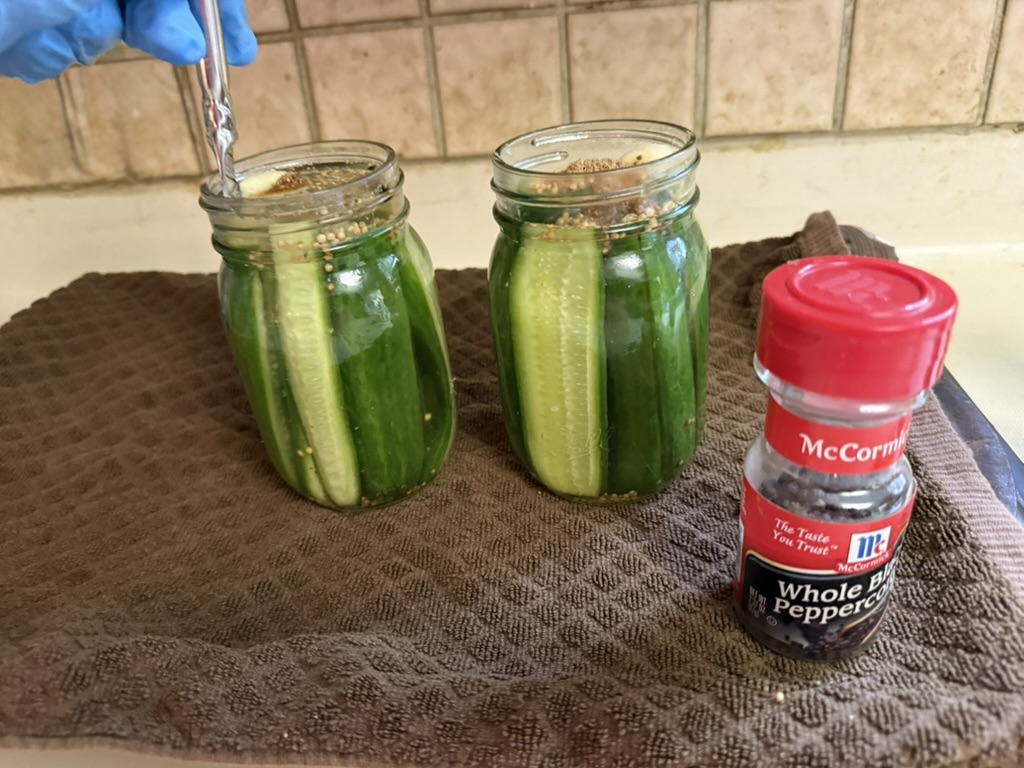
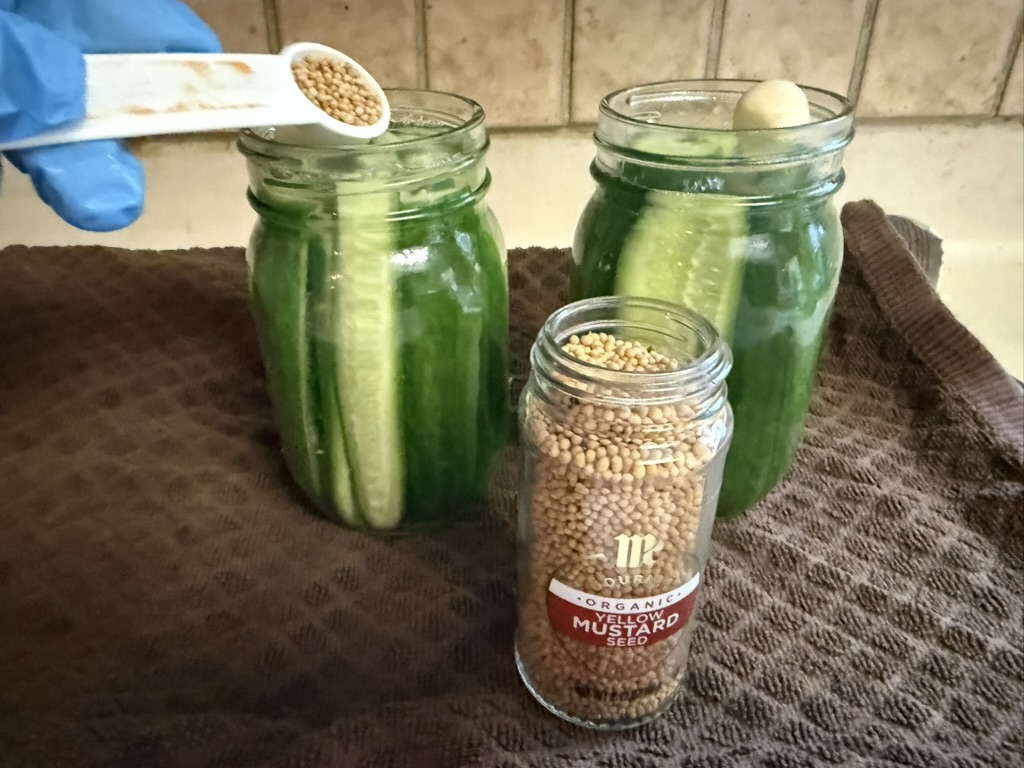
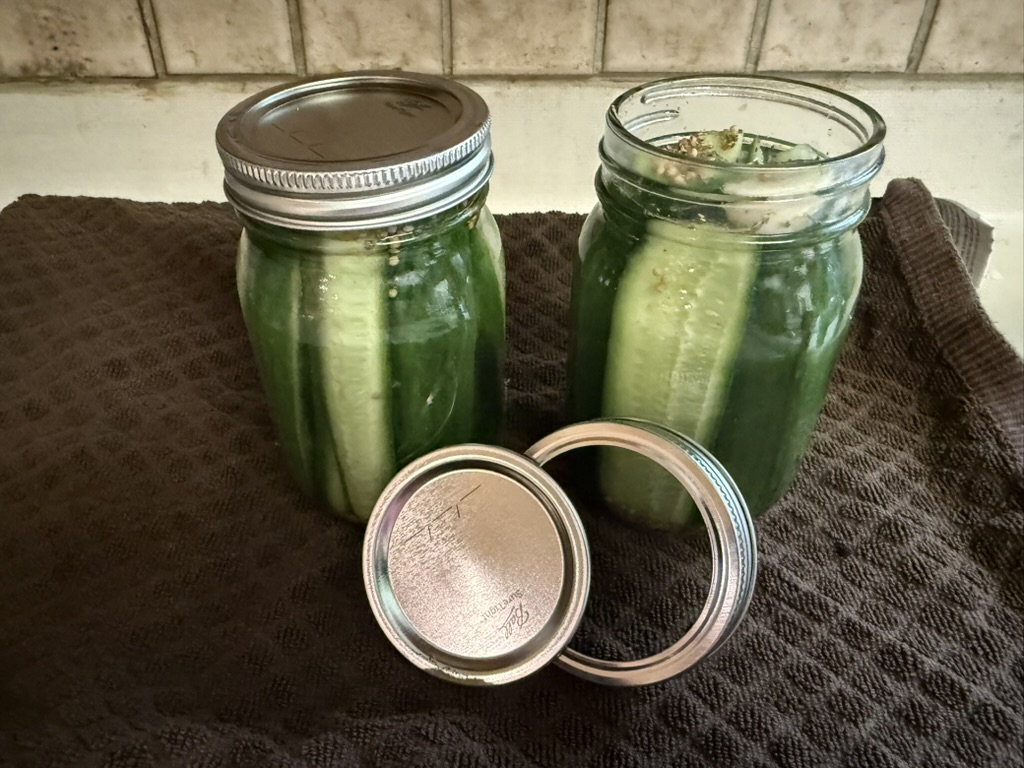
Invert the jars to mix the spices, mustard seed and garlic.

If using a 28 ounce Classico® Atlas Mason pasta jars, reduce the cucumbers to 1 pound. This amount will fit into one jar. The brine will be about the correct amount, there may be a little left over. Use only 1 garlic clove. and the amounts of mustard seed, black peppercorns, celery seed and coriander for one jar.

Let the pickles “cure” for several days prior to using.
These refrigerator pickles are delicious. And, they get better with time. I recommend that these pickles steep in the brine for several days so the cucumbers can absorb the flavors of the brine, garlic and spices before you eat them.
Store these pickles in the refrigerator. Although, hopefully, you sterilized the jars, the pickles are not heat-processed or pressure processed as with home canning (which would sterilize the pickles). So the jars are not shelf stable, store them in the refrigerator.
Then enjoy! For a snack or on a sandwich or in recipes.

Are these mustard pickles like the ones which my husband remembers them from his childhood? It is hard to say; but he loves that these pickles are crisp and mild, with lots of mustard seed! I think we’ve come close with this recipe.
If you have an interest in the farm-to-table movement, now is the time to get started. Commercial greenhouse cucumbers have really changed the dynamics of home canning. These cucumbers are consistent in quality, size and flavor. It has make home canning on a small scale such a breeze. Enjoy!
Cold Brine Mustard Pickles for the Casual Cook
Ingredients:
- 1-1/2 lb mini-cucumbers (5″ or less in length)*
- 1-1/2 cup water
- 1/2 cup distilled 5% white vinegar
- 1 Tbsp sea salt or un-iodizing table salt
- 2 large or 4 small garlic cloves, peeled
- 2 tsp whole mustard seed
- 6 black whole peppercorns
- 1/4 tsp celery seed, optional
- 1/4 tsp coriander seed, optional
- Sterilize canning jars and lids prior to using, Either wash in dishwasher on high heat or add to large pot, cover with water and boil for 5 minutes. Keep jars hot until ready to fill with cucumber spears.
- Wash cucumbers, do not peel. Do not use cucumbers with blemishes. Cut off stem and blossom ends. Cut into lengthwise halves, then into spears.
- Combine, water, vinegar and salt in a heavy medium-sized saucepan. Heat to boiling, stirring occasionally, to dissolve salt. Remove from heat.
- Pack cucumber spears into hot, sterilized jars.
- Fill jars with hot brine, to 1/2″ from top of jar. (A small amount of brine may remain. DiScard extra brine.
- Add one large (or two small) garlic cloves to each jar.
- Add 1 tsp mustard seed to each jar, followed by 3 black peppercorns, 1/8 tsp celery seed (if using) and 1/8 tsp coriander seed (if using) to each jar.
- Immediately add hot lids (rings and seals.
- Let cool to room temperature. Then refrigerate.
- Label and date.
- For best flavor, let “cure” in refrigerator for several days before using.
- Use with one month
Method and Steps:
*NOTE: If using a 28 ounce Classico® Atlas Mason pasta jars, reduce the cucumbers to 1 pound.


Yum