 Maylee at Beyond Gumbo
Why would anyone want to make their own “Tabasco Pepper Hot Sauce”? And, the answer is, “why not”? Ever since we visited the Tabasco® Pepper Hot Sauce plant on Avery Island, Louisiana, several years ago in August, I’ve been fascinated to see if I, too, could grow Tabasco peppers and make hot sauce. So, that summer I planted one Tabasco pepper plant in my backyard garden. It grew prolifically. That’s my kind of pepper. However, the tiny ripe Tabasco peppers were really too small to yield even one bottle of hot sauce. This year I planted an entire row of Tabasco peppers. Success; my Tabasco pepper plants resulted in a hot sauce with that characteristic flavor and aroma of the real Tabasco Pepper Hot Sauce. And mine sure packs alot of punch! Now l have a wonderful hot sauce to add a homemade “spark” to jambalaya and gumbos and any other Cajun food which I might be cooking. For this experiment, I felt like an apothecarist mixing up a potion. But is it practical for the everyday cook? Probably not; however, I love a creative challenge and I enjoyed learning all about growing Tabasco peppers. Perhaps I’ll try different peppers next summer.

The real Tabasco Pepper Hot Sauce
In Louisiana, Tabasco® Hot Sauce is the real hot sauce. It is a red hot pepper sauce and is almost always found on restaurant tables for customers to liberally season their own meals. Although there are many “knock-off” hot sauces, Tabasco Hot Sauce is “king.” It just can’t be beat. First, this red pepper sauce is “hot.” Second, the flavor profile is unique and pleasing. It is different from other peppers such as Hatch, habanero, jalapeño, chipotle, sriracha, and scorpio. And, the quality of the Tabasco brand sauce is consistent. Go anywhere around the country, their brand of Tabasco Hot Sauce tastes the same. We stopped for breakfast in Lake Charles, Louisiana, recently. Gotta’ have that hot sauce for those scrambled eggs.

And here is a neighborhood restaurant in a suburb of New Orleans, The Harbor Bar and Grill. If you want the best food the area, go where the locals eat. The seafood food at this unassuming restaurant was delicious. And what was on the tables? Why, Tabasco Hot Sauce, of course.

The Tabasco® Hot Sauce brand is produced at Avery Island deep in the Cajun part of the state. Several years ago, we made the three-hour drive and took a day trip to visit the manufacturing facilities. We were literally at the end of the road; next to the swamps and marshes leading to the Gulf of Mexico.


Avery Island is not rally an “island,” but rather a series of salt domes. (The salt comes in handy during the fermentation process of making the pepper sauce.) Other that modernization of equipment, the recipe and process for producing Tabasco Hot Sauce really hasn’t changed since the 1868 when Edmund McIlhenny founded the company. The pepper mash is still fermented in white oak wooden barrels for up to three years! The fifth generation, family-owned business has developed a self-guided tour for visitors which teaches the history of the island and company and process of making Tabasco Hot Sauce. The tour is informative and interesting. I tried to pay attention to what was going on, in hopes of making my own Tabasco pepper sauce.

I purchased this little cookbook, “The Tabasco® Brand Cookbook,” in their company store. It includes favorite vinage recipes from the family as well as interesting history and many old photos of growing Tabasco peppers on the plantation years ago. A treasure if up are a history buff.
Tabasco peppers are the variety used to make the red pepper sauce. Tabasco refers to the state in Mexico where the peppers originated. According to the story, the seeds were brought to New Orleans in the 1800s by a trader and given to the McIlhennys. In warm climates (such as Avery Island south of us), Tabasco peppers are a perennial plant. The plants on Avery Island were easily four feel tall! Although the seed stock always originates at the McIlhenny plantation, the Tabasco plants are now grown in Latin America and Africa (and hand picked). One of my plants wintered over and grew again in the spring. However, because of last winter’s freeze, I had to replant the rest of my plants. Here are several of my plants growing this summer.

The peppers are tiny; not more than an inch long. They grow upright on the plant. As you can see, the peppers ripen at different times. This makes it difficult to pick enough to make a large batch of hot sauce.
As far as growing these plants at home; I just planted the seedlings in my garden (with fertilizer) and left them alone. I didn’t even water them in the summer heat. Again, my kind of plant!
To produce Tabasco Pepper Sauce according to the McHenney process, the peppers are hand picked using a chart which specifies the color and size which the peppers must meet in order to be picked. As described in Wikipedia, the peppers are ground into a mash the day they are picked and mixed with salt. The mash is placed in white oak barrels to age for two to three years at room temperature. Then, the mash is strained to remove skins and seeds and mixed with white vinegar. This percolates for up to a month; then the sauce is distilled off and bottled.
DIY Recipe
My recipe for making the hot sauce is straightforward and slightly different compared to the process used by the McIlhenny family. For example, how could I ferment pepper mash for two years? Not realistic for a home cook. My recipe is simple and contains only three ingredents — Tabasco peppers, distilled white vinegar and salt (plus water). The hot sauce is basically a mash which is seeped in vinegar and a little salt.

Here’s what I did.
Step One: Gather as many red ripe Tabasco peppers as possible. My yield today was 1/2 cup and it weighed 2.5 ounces. Pick only the best, red peppers. Discard any with blemishes and ones which are not ripe — such as the cream colored one, shown above.. As additional peppers ripen, you can add them to the mash in successive days in batches.

Step Two: Sort, rinse any bugs (yes, there will be bugs) and debris off the peppers. Remove the stems and leaves and discard.

Step Three: Put the peppers in a small food chopper in batches. Add 1/4 cup water and chop up as much as possible. Leave seeds and skins on. (These peppers are “potent.” For this step, I do not recommend chopping by hand with a knife.)

Step Four: Transfer to a small pot along with the water. Add 1/2 cup white vinegar and 1/2 teaspoon salt and stir. Leave uncovered. Place on stove and gently boil for 5 minutes.


Step Five: Transfer the “mash” to a small bowl and cover. Let the mash steep in refrigerator for one or more weeks. As more peppers ripen on the vines, chop, boil in a small amount of vinegar/water (omit additional salt) and add them to the “mash.”
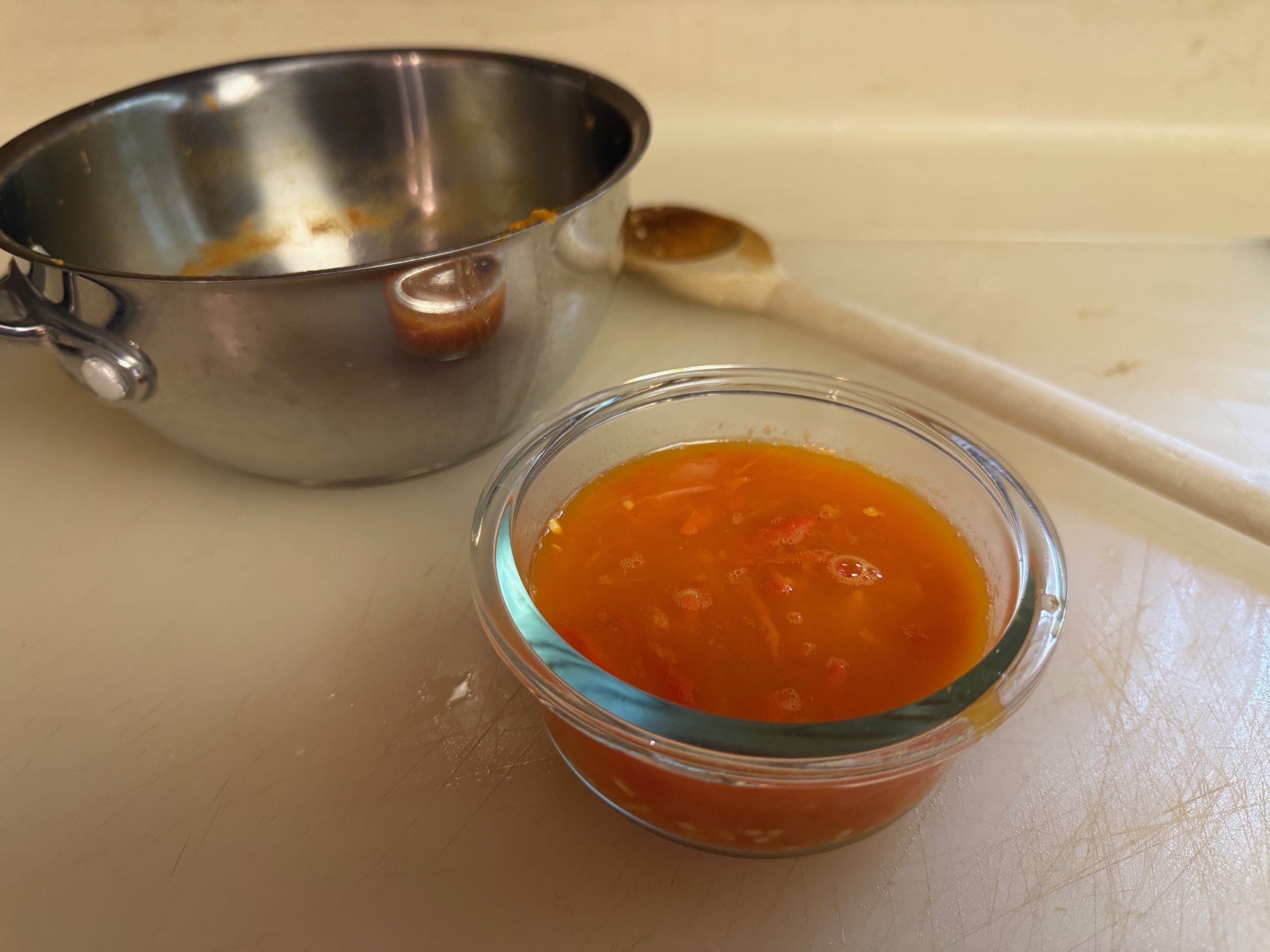
Step Six: When ready to finish, press the mash through an old fashioned food mill or a fine sieve removing seeds and skins. If working by hand, use the back of a spoon and apply some pressure to extract the liquid. Discard the seeds and skins — the hot sauce is the liquid which is pressed through the sieve into the bowl. (Don’t discount this food mill. It is amazing simple and hasn’t changed over the years. I have found many indispensible uses for it such as straining apples for apple butter, making mashed potatoes and pureeing tomatoes for sauce. The aluminum food mills are available on Amazon.)


Transfer to sterile jars. (To sterilize jars, boil jars and lids for 5 minutes.). Store the sauce in the refrigerator where it will last for several months.
Yeah! We have DIY Tabasco Hot Sauce. Much simpler than the McIlhenny family process. I have one batch finished and more peppers ready to start the process.

My pepper sauce is extremely “hot.” The sauce packs a punch; you only need a drop or two added to a dish to add heat.
At restaurants, Louisiana natives sprinkle Tabasco Hot Sauce on fried catfish, jambalaya, gumbo and anything which needs a little extra pizzaz. Even scrambled eggs. We like it hot down here.

Making my own hot sauce was a sort of a crazy experiment which has been on my “to do” list of projects for several years. I am pleased that my Tabasco sauce tasted remarkably similar to the real Tabasco Pepper Hot Sauce. And, now that I have discovered how simple it is; you bet I wlll make more hot sauce next summer. And, I am guessing that you can make hot sauce using other kinds of peppers too, such as cayenne or habanero peppers. Perhaps a different flavor profile; but tasty, I’m sure. Let’s see what next summer brings.
Whether you make your own Tabasco Hot Pepper sauce or purchase it, this sauce is a staple in Louisiana homes. Enjoy!
If you ever plan a trip to visit Louisiana and the Cajun part of our country — put a visit to Avery Island as one of your stops.
DIY Tabasco Pepper Hot Sauce
Ingredients:
- 1/2 cup (2.5 oz) Tabasco peppers
- 1/4 cup water
- 1/2 cup distilled white vinegar
- 1/2 tsp salt
Method and Steps:
- Rinse and sort peppers to remove bugs and debris. Use only peppers which are red and ripe; discard peppers which are immature (cream colored) and those with blemishes.
- Remove stems and leaves and discard.
- Working in batches, add peppers and water to small food chopper or food processor bowl. Chop up as much as possible retaining seeds and skins.
- Transfer chopped peppers and water to a small sauce pan. Add white distilled vinegar and salt and stir. Gently boil, uncovered, for 5 minutes.
- Remove from the heat, cool, and transfer to a small bowl. Cover.
- Allow to steep in refrigerator for 1 to 2 weeks.
- Using a food mill or fine sieve, strain to remove seeds and solids. If straining by hand, press down with force — using the back of a spoon — to extract as much liquid as possible into a bowl. Discard the solids; the liquid is the Tabasco sauce.
- Transfer the sauce into a sterilized jar. (Sterilize the jar by boiling jar and lid in water for five minutes.)
- Store in refrigerator up to 6 months.
- Shake well before each use.


I have read that Avery Island, home of Tabasco, is not an actual island, but kind of a salt dome, a geologic feature which was useful for the hot sauce production. So, is Avery Island an island?
Dang. Should have read the headnotes first.
Yes, Avery “Island” is on top of salt domes. It is private property and you really can’t explore what is there. The tabasco production plant appears to be on land in the front which is protected by levees as a large bayou goes along the property. It is a different place down there.
One of the coolest trips I have made … the “island” goes on forever and is beautiful.
Yes, it is a different world, at Avery Island. I loved our trip there! May go again this summer.